Oronsuuts: The Complete Guide to Mongolia’s Apartment Living System
Quick Facts Table
| Category | Detail |
| Term | Oronsuuts (Орон сууц in Mongolian script) |
| Language of origin | Mongolian |
| Literal meaning | “Oron” = place/space + “Suuts” = dwelling/residential unit |
| English translation | Apartment housing / Residential living space |
| Primary location of use | Ulaanbaatar, Mongolia |
| Also used in | Other Mongolian cities: Erdenet, Darkhan |
| Housing system type | Multi-unit apartment buildings with shared services |
| Key feature | Central heating (critical for -40°F winters) |
| Historical origin | Soviet-era housing construction (post-1940s) |
| Population of Ulaanbaatar | ~1.7 million (2025 estimate) |
| Ulaanbaatar housing growth | New apartment prices up ~15.7% in 2024 |
| Alternative to | Traditional Ger (yurt-style) districts |
| Online confusion | Sometimes misused as a streaming/digital platform name |
A Word That Carries an Entire Way of Life
Imagine you just landed in Ulaanbaatar, Mongolia’s capital city. It is January. The sky is a steel gray. Your breath turns to steam the moment you step outside.
You need somewhere warm. Somewhere safe. Somewhere you can actually call home.
That is the moment the word oronsuuts becomes personal.
It is not just a housing term. In Mongolia, it is the word millions of people use every single day when they talk about where they live, where they want to move, and what kind of future they are building for their families.
And yet, if you search for it online outside of Mongolia, you will find a strange mix of results — apartment listings, digital tools, even streaming websites using the word in completely unrelated ways. This tutorial was created precisely to address that uncertainty.
Let’s start from the beginning.
What Does Oronsuuts Actually Mean?
Peel the word apart and you find two pieces.
“Oron” means place or space in Mongolian. “Suuts” means a dwelling — a spot where a person actually lives.
Put them together and you get something that means far more than just four walls and a ceiling.
The full Mongolian phrase is орон сууц. When Mongolian is written in the Latin alphabet for international use, those letters become “Oronsuuts.” This is called transliteration — swapping one alphabet’s letters for another’s while keeping the sound the same.
The word describes apartment-based housing. Not a single family home. Not a traditional tent. A building where many families each have their own home, but share the structure, the stairwells, the heating system, and the daily rhythms of living side by side.
Think of it this way. Oronsuuts is the word Mongolians use the way Americans say “apartment building” — except it carries more cultural weight, more history, and far more practical importance in a country where winter can kill.
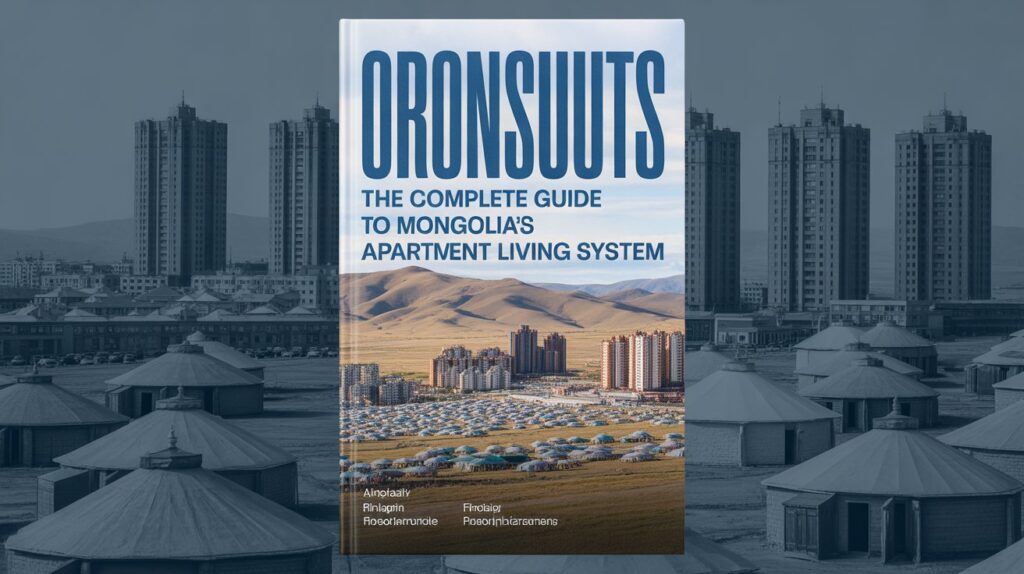
Mongolia: The Country That Made This Word Essential
Before you can fully understand oronsuuts, you need to understand Mongolia.
This is one of the world’s most landlocked, most sparsely populated, and most climatically extreme countries. The land stretches across 604,000 square miles. Only about 3.3 million people live there — roughly the population of Los Angeles spread across a country twice the size of Texas.
But those people are increasingly piling into one city.
Ulaanbaatar is the capital. It sits in a valley surrounded by mountains. In 2001, about 630,000 people lived there. By 2025, that number had climbed to roughly 1.7 million. That is almost a 170 percent increase in under 25 years.
Nearly half of Mongolia’s entire population now lives in a single city. And that city keeps growing, drawing in families from the countryside at a rate of around 25,000 new arrivals every single year.
All of those people need somewhere to live.
That is where oronsuuts becomes the most important word in Mongolian urban life.
The History Behind the Buildings
Oronsuuts did not pop up overnight. Their story goes back almost a century.
When Mongolia came under heavy Soviet influence in the 20th century, the government began building apartment blocks across Ulaanbaatar. The goal was practical — house workers, house families, house a growing industrial workforce. The early buildings were plain. Concrete. Functional. Not beautiful, but solid.
These Soviet-era structures introduced something completely new to Mongolian life: shared living infrastructure. Central heating pipes running through every wall. Running water in every kitchen. Planned streets and organized city blocks.
For a nation that had lived nomadically for thousands of years — moving with the seasons, carrying homes on the backs of camels and yaks — this was a radical change.
Families went from circular felt tents to multi-story concrete buildings. The ger, that iconic round dwelling of the Mongolian steppe, was suddenly sharing space with elevator buttons and radiator heat.
Those early apartment buildings are still standing in Ulaanbaatar today. You can spot them — gray, blocky, worn at the edges but still full of families. Next to them now rise gleaming new towers with glass facades and underground parking.
Both the old and the new are oronsuuts. The word spans generations.
The Ger District Problem: Why Oronsuuts Matters So Much Today
Here is the tension that drives everything in Ulaanbaatar right now.
Roughly 60 percent of the city’s population still lives in what are called ger districts — sprawling neighborhoods on the outskirts where people live in traditional round tents or basic wooden homes on small plots of land.
Ger districts are deeply meaningful to Mongolian culture. The ger itself is one of the most ingeniously designed portable structures ever created. People have lived in them across the steppe for centuries.
But in a city of 1.7 million people, ger districts come with serious problems.
There is no central heating in most of them. Families burn raw coal and wood to stay warm. In a city where winter temperatures can drop to -40°F (-40°C), that coal smoke fills the valley like a thick brown blanket. Ulaanbaatar regularly ranks among the world’s most polluted cities during winter months.
There is often no running water or proper sanitation either. Water trucks deliver supplies to some areas. Others rely on wells and outdoor facilities.
More than 850,000 people — roughly half the capital’s population — were living in these conditions as recently as 2017. The number has shifted as new housing is built, but the challenge has not gone away.
This is the pressure that makes oronsuuts so vital. Apartment buildings with central heating, clean water, and proper waste systems are not a lifestyle upgrade for many families — they are a life-changing move toward safety and health.
What Life Inside an Oronsuuts Building Actually Looks Like
Forget the statistics for a moment. Picture a regular Tuesday morning inside an oronsuuts apartment.
The room is warm when you wake up. This matters more here than almost anywhere else on Earth. Mongolia is one of the coldest countries on the planet, and a working heating system is not something families take for granted.
You turn on the tap and clean water runs. Not something everyone in the city has.
You hear your upstairs neighbor walking. The walls are not always thick. In older Soviet-era blocks, sound travels easily from floor to floor and apartment to apartment.
You walk to the shared stairwell to take out trash or pick up a package. You pass your neighbor from the third floor — an older woman who has lived in the same apartment since the 1980s. A young couple moved in on the second floor last month. Students rent the corner unit on your floor.
This is community living, Mongolian style. Not everyone chooses it enthusiastically. But for millions of people, it is the path to a stable, modern, warm life in a city that is growing faster than it can keep up with itself.
The Key Features That Define Oronsuuts
Not all apartment buildings are the same. But oronsuuts — as a system — have defining features that set it apart from just any building.
Central heating is the most critical one. Mongolia’s winters are brutal, and oronsuuts buildings are connected to district heating networks — massive city-wide pipe systems that push hot water through buildings from centralized plants. This is not optional. Without it, the building would be uninhabitable for half the year.
Multi-story design allows a city with limited flat land to house large numbers of families. Older buildings run five to nine stories. Newer towers can reach 25 stories or more.
Shared infrastructure means every family plugs into the same water system, the same sewage system, and in older buildings, the same heating schedule. You do not control when your heat turns on — the city does. That is a cultural adjustment for newcomers.
Property management systems handle repairs, common area cleaning, elevator maintenance, and building security. Quality varies enormously between buildings. Residents often pay monthly maintenance fees that cover these services.
Proximity to city services is built into the oronsuuts model. Schools, clinics, public transport, shops — these cluster around apartment zones by design in the planned portions of the city.
Buying vs. Renting an Oronsuuts: How the Market Works
The Ulaanbaatar housing market has been running hot.
Between 2023 and 2024, new apartment prices jumped by more than 15 percent each year. Older apartments climbed nearly 19 percent in 2024 alone. The pressure on families trying to find a home is very real.
Most people approach oronsuuts one of two ways.
Renting is common, especially for young professionals, students, and families who just moved from rural areas. Renters look closely at three things: which district the apartment is in, whether the heating is reliable, and how close it is to schools and workplaces. Lease agreements vary — some landlords include utilities, many do not. Reading the fine print matters here, especially around heating costs.
Buying is the goal for most families who can manage it. Ownership is registered through official government channels. Before signing anything, serious buyers check the developer’s track record, verify ownership documents, and usually have the apartment physically inspected. A property that looks new on the outside can have serious plumbing or heating issues underneath.
The Mongolian government also runs targeted housing assistance programs for lower-income families, using oronsuuts stock to provide subsidized homes. Eligibility is based on income levels and family circumstances. Applications are handled through digital registration portals.
The Environmental Challenge Hidden in Plain Sight
There is a tension inside the story of oronsuuts that does not get discussed enough.
The shift from ger districts to apartment buildings genuinely improves individual living conditions. But it does not automatically fix the city’s massive air pollution problem.
The old coal-burning heating stoves in ger districts are the main culprit for Ulaanbaatar’s famous winter smog. When families move into centrally heated apartment buildings, their personal coal use drops dramatically — which is good.
But the centralized heating plants that warm those apartment buildings also burn coal. The pollution just moves from thousands of small stoves to a handful of large smokestacks.
The Asian Development Bank and the Green Climate Fund have committed hundreds of millions of dollars to help Ulaanbaatar build eco-districts — new planned neighborhoods that combine affordable oronsuuts-style apartment living with cleaner energy, better insulation, and lower emissions.
A major project targets converting ger area land into 10,000 new affordable green housing units and redesigning 100 hectares of informal settlements into organized eco-districts. The goal is not just to house people better — it is to let them live in a city they can breathe in.
That work is ongoing, with a completion horizon of 2027.
Oronsuuts in the Digital Age: A Word That Traveled Online
Here is where things get a little unusual.
The word oronsuuts is now showing up in contexts far beyond Mongolia’s housing market.
Some websites use it as a name for digital platforms, creative tools, or online content services. A few streaming-adjacent sites have adopted the word — sometimes because the name sounds distinctive and modern to international ears, sometimes for murkier reasons involving search engine optimization.
This matters because if you search “oronsuuts” online without knowing the context, you might land on pages that have nothing to do with Mongolian apartments. Some of those pages are harmless curiosities. Others may be unofficial or potentially unsafe platforms using the exotic-sounding word as a brand name.
The safe rule: if a page using the word “oronsuuts” is not discussing Mongolia, housing, or the Mongolian language, approach it carefully. The true home of this word is squarely in Central Asian urban planning — not in streaming tech or digital media.
The Future of Oronsuuts in Mongolia
The word is not going anywhere. If anything, it is becoming more central to Mongolian life.
With Ulaanbaatar’s population still growing and rural-to-urban migration continuing at 25,000 people per year, the demand for apartments will not slow down. The city needs tens of thousands of new housing units over the next decade.
Architects and urban planners in Mongolia are increasingly focused on building smarter oronsuuts — apartments with better insulation, solar panels on rooftops, triple-glazed windows for extreme cold, and sustainable heating systems that do not rely entirely on coal.
Young Mongolians who grew up in ger districts and are now raising their own children in city apartments represent a generation for whom oronsuuts is simply home — the only home they have ever known.
And a new generation of architects, raised in those same buildings, is now designing the next version of them.
Final Words
Oronsuuts is one of those words that looks small on the page but carries an enormous weight of human meaning behind it.
It is a Mongolian apartment. A shared building. A central heating system keeping a family warm when the thermometer reads -40. A young couple signing their first lease. A grandmother who has lived on the third floor for forty years. A child growing up without ever knowing what it feels like to haul water from a truck.
It is the story of a nomadic people adapting to city life — not abandoning their culture, but adding to it. Building on top of it. Literally.
The next time you hear the word oronsuuts, you will know exactly what it means. Not just “apartment.” But home, warmth, community, and the ongoing challenge of building a livable city in one of the most extreme climates on Earth.
FAQs
Q1. What does oronsuuts mean in English?
The Mongolian word “oronsuuts” means “residential housing” or “apartment dwelling.” It comes from two Mongolian words: “oron” meaning place or space, and “suuts” meaning a dwelling unit. Together they describe a complete apartment-based living system, not just a single flat.
Q2. Where is the word oronsuuts used?
It is used primarily in Mongolia, especially in Ulaanbaatar, the capital. It also appears in other Mongolian cities like Erdenet and Darkhan. Outside Mongolia, the word shows up in diaspora communities, international housing research, and — confusingly — some unrelated digital platforms that have borrowed the name.
Q3. How do you pronounce oronsuuts?
In Mongolian, it sounds roughly like “OH-ron-soots” with a short, clean vowel in the middle syllable. The double “u” at the end represents the Mongolian “uu” vowel sound, which is similar to a longer “oo” as in “food.”
Q4. What is the difference between a ger and an oronsuuts?
A ger is the traditional round felt tent that Mongolian nomads have used for thousands of years. It is portable, culturally iconic, and still widely used. An oronsuuts is a permanent apartment in a multi-story building with central heating, running water, and shared infrastructure. Many Mongolian families have transitioned from ger district living to oronsuuts as cities have grown.
Q5. Why is central heating so important in oronsuuts buildings?
Mongolia experiences some of the coldest winters of any populated country. Ulaanbaatar temperatures regularly drop to -40°F (-40°C). Central heating in oronsuuts buildings is connected to the city’s district heating network — a system of hot-water pipes running under the streets. Without it, apartments would be completely uninhabitable through the long winter months.
Q6. Are oronsuuts apartments affordable?
It depends on the location and age of the building. Older Soviet-era apartments are generally more affordable. Newer developments with modern finishes and better insulation cost significantly more. Between 2023 and 2024, new apartment prices in Ulaanbaatar rose more than 15 percent per year, putting pressure on middle and lower-income families.
Q7. Does the Mongolian government provide oronsuuts housing assistance?
Yes. The government operates subsidized housing programs targeted at low and middle-income families. Eligibility is based on income levels and household circumstances, and applications are managed through digital registration systems. International organizations including the Asian Development Bank and the Green Climate Fund have also funded major affordable housing projects in Ulaanbaatar.
Q8. What is an eco-district and how does it relate to oronsuuts?
An eco-district is a newly planned neighborhood that combines apartment-style housing (similar to oronsuuts) with clean energy systems, better insulation, reduced coal dependence, and improved waste management. Several large-scale eco-district projects are currently underway in Ulaanbaatar, aimed at replacing polluting ger districts with modern, affordable, and environmentally cleaner housing. Major completion targets are set for 2027.
Q9. Why does oronsuuts sometimes show up on streaming or tech websites?
Some websites have adopted the word as a brand name because it sounds distinctive and modern to non-Mongolian ears. It has nothing to do with the actual meaning of the word. These platforms have no connection to Mongolian housing. Some of them are unofficial or potentially unsafe. If a site using the word is not discussing Mongolia or housing, treat it with caution.
Q10. What should I check before renting an oronsuuts apartment?
Three things matter most. First, check the heating reliability — especially in older buildings, because heating quality varies widely. Second, confirm what utilities are included in the rent, as arrangements differ between landlords and properties. Third, check the location relative to schools, public transport, and your workplace, since Ulaanbaatar traffic can be intense.
Q11. How many people live in oronsuuts-style apartments in Ulaanbaatar?
As of recent estimates, approximately 40 percent of Ulaanbaatar’s population of 1.7 million lives in formal apartment housing. The remaining roughly 60 percent still live in ger districts on the city’s periphery. That gap is the central challenge driving billions of dollars in housing investment.
Q12. How old are the oldest oronsuuts buildings still in use?
Many Soviet-era apartment buildings constructed in the 1950s, 1960s, and 1970s are still occupied in Ulaanbaatar today. Some have been renovated or have had major systems updated. Others remain in their original condition. Residents of older buildings sometimes report that the heating is actually more consistent than in some newer developments, because Soviet-era construction standards for insulation were designed specifically for extreme cold.
Q13. Is the oronsuuts system unique to Mongolia?
The word is uniquely Mongolian. But the concept — large-scale shared-service apartment housing built during the Soviet era — exists across many former Soviet and Eastern Bloc countries. Similar housing systems can be found in Russia, Kazakhstan, Ukraine, and Central Asian republics. What makes Mongolia’s version distinctive is the cultural context: a nation transitioning from nomadic traditions into dense urban apartment life within just a few generations.
Come back to K and V nails for smarter ways to stay informed.