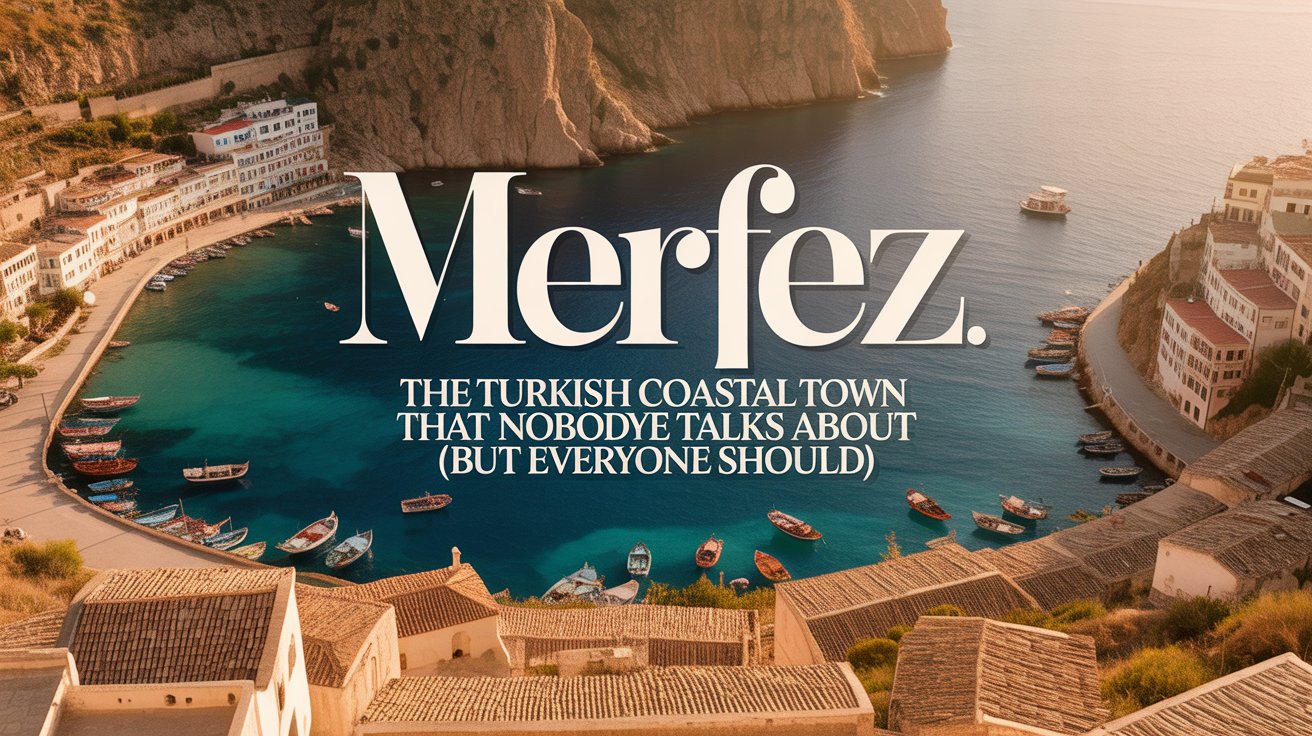
Merfez: The Turkish Coastal Town That Nobody Talks About (But Everyone Should)
Okay so here’s the thing.
You’ve heard of Istanbul. You’ve heard of Cappadocia. Maybe Bodrum or Antalya if you’re really into Turkey. But Merfez? Probably not.
And that’s kind of the point.
Quick Facts
| Detail | Information |
| Location | Southern Mediterranean coast, Turkey (near Mersin/Adana region) |
| Type | Coastal town / cultural destination |
| Historical influences | Phoenician, Byzantine, Venetian, Ottoman |
| Nearest airport | Adana Şakirpaşa Airport (~70 km) |
| Best seasons to visit | April–June and September–October |
| Known for | Ancient ruins, turquoise waters, Kizkalesi Castle, Heaven & Hell Caves |
| Word origin | Related to Turkish menfez — meaning aperture, passage, culvert |
| Modern meaning | Also used as a concept: intentional living, slow travel, authentic creativity |
| Vibe | Quiet. Real. Unhurried. |
| Trending since | 2025–2026 in slow travel and digital minimalism communities |
The First Thing You Notice When You Arrive
Nobody’s rushing.
That’s genuinely the first thing people say about Merfez. You land in Adana, take a taxi for under an hour, and somewhere along the way the road slows down. The honking stops. The hills get greener. And then there’s this coastline — just sitting there, completely unbothered, doing its thing.
The water is that specific shade of blue-green that doesn’t look real in photos. You think the pictures are filtered. They’re not.
The old streets are cobblestone. Uneven. Slightly exhausting if you’re dragging a wheeled suitcase. But honestly? You stop minding. Because every ten meters there’s something — a carved wooden doorway, an old stone wall with vines running across it, a local woman selling dried figs from a small basket like it’s 1970.
Merfez isn’t performing for you. It’s just existing. That’s rare.
A Town That’s Been Around Since Before Maps Were a Thing
Let’s talk about history for a second, because this part is actually wild.
Merfez sits on a stretch of Turkish coastline that humans have lived on for roughly 8,000 years. That’s not a typo. Eight thousand years. The Neolithic era. Back when humans were just figuring out farming.
After that came the Phoenicians — master seafarers and traders who stopped here because the location was perfect. Then the Byzantines moved in and built things in stone. Then Venetian merchants passed through and left their mark. Then the Ottomans arrived and, as they did everywhere, layered their own architecture over everything that came before.
What you get today is this strange, beautiful palimpsest. A town where you can find Byzantine-era carvings sitting next to an Ottoman mosque sitting next to a guesthouse with Wi-Fi.
The Merfez Archaeological Museum holds pieces from all these eras. Mosaics. Roman-era statues. Items from trade routes that don’t exist anymore. Walking through it feels less like a museum visit and more like accidentally overhearing someone’s ancient family history.
Kizkalesi — The Castle That Rises Out of the Sea
Okay this is where it gets genuinely dramatic.
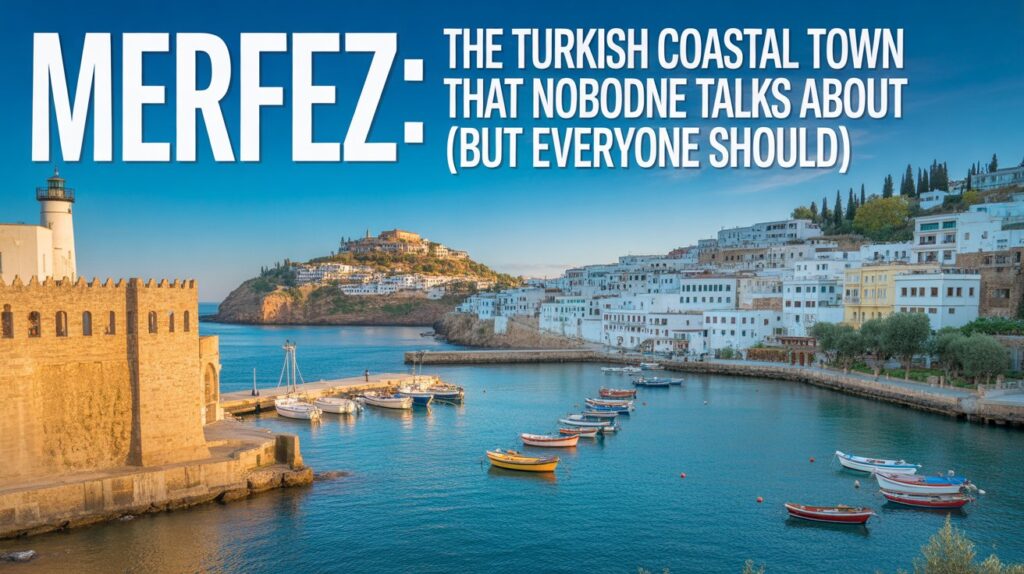
About a short boat ride from Merfez sits Kizkalesi — the Maiden’s Castle. It’s a medieval fortress that sits entirely on a small island in the sea. Just… out there. In the water. Rising up from nowhere.
The local legend says a king built it to protect his daughter after a prophecy told him she would die from a snake bite. He thought the sea would keep her safe.
(It didn’t. A snake arrived in a fruit basket. That’s the legend anyway.)
But the castle is real. And it’s stunning. You can take a boat out to it in the morning when the light is soft and the water is calm, and stand up on the walls and look back at the coast, and it’s the kind of view that makes you forget you have a phone to check.
Most people who visit Merfez say Kizkalesi is the thing they keep thinking about weeks after they leave.
Heaven and Hell — No, Literally
A short drive from town brings you to two enormous sinkholes carved out of the limestone by underground rivers over millions of years.
The locals call them Cennet ve Cehennem. Heaven and Hell.
Heaven — the deeper, more accessible one — has 452 stone steps carved into the rock. You go down, and down, and down, until the temperature drops and the light changes and it smells like wet earth and old time. At the bottom is a small chapel dedicated to the Virgin Mary, standing next to an underground stream that runs clear and cold.
Hell is a 120-meter vertical drop. You can’t go down into it. You can only stand at the edge and look. According to local mythology, this was the actual entrance to the underworld — the place where Zeus imprisoned the monster Typhon.
Standing at the edge of Hell with the Mediterranean sun on your back is a very specific kind of experience. It doesn’t feel like a tourist attraction. It feels like the earth reminding you that it’s been here much longer than you.
The Food — This Is Where Things Get Personal
Merfez is not the place for restaurant chains.
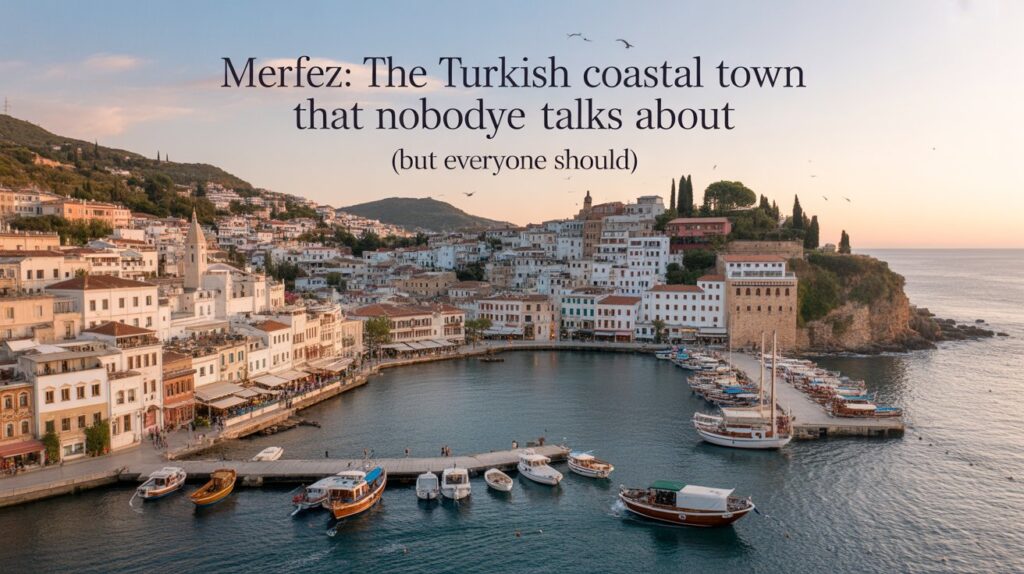
Everything here is small. Family-run. The menu changes based on what came in on the boat that morning. There’s no Instagram-optimized plating. Just a plate, some grilled fish, olive oil that tastes genuinely different from anything you buy in a supermarket, and a glass of ayran — that cold yogurt drink that somehow works with everything.
Street food runs the town during the day. Grilled corn. Flatbreads stuffed with spiced fillings. Kumpir — a fully loaded baked potato that sounds simple and then you eat one and you’re confused about why this isn’t everywhere.
And the breakfasts. Turkish breakfasts are already legendary. But in Merfez, at a family guesthouse, the morning spread is something else. Olives. Four types of cheese. Tomatoes and cucumbers. Honey. Eggs. Bread is still warm from the oven. Tea served in small tulip-shaped glasses. The kind of breakfast that takes an hour to get through, in the best possible way.
There’s no rushing through a Merfez breakfast. That’s not how it works here.
The Word Itself — Where Did “Merfez” Come From?
This is where it gets interesting in a different way.
The Turkish word menfez — which sounds similar and is sometimes written as merfez in transliteration — means aperture. Passage. Opening. In civil engineering, it’s the word for a culvert: a channel that lets water flow from one side of a road or barrier to the other.
A passage beneath something solid. A way through.
That’s actually a pretty poetic root for a place that feels like an opening into a different pace of life. You go through Merfez and something on the other side is different.
In 2025 and 2026, the name started appearing in online conversations well beyond travel content. Productivity communities, digital minimalism writers, slow-living advocates — all of them started using “merfez” as shorthand for a certain kind of approach. Slower. More deliberate. Less noise. One thing done well instead of ten things done poorly.
Whether that meaning came from the place or grew alongside it, the overlap feels true.
Why People Are Suddenly Talking About It in 2026
Here’s the thing about slow travel and digital burnout — they peaked at the same time.
Post-pandemic, people started moving away from Instagram-perfect destinations and toward places that felt real. Merfez was always real. It just wasn’t famous enough to be ruined yet.
Smaller guesthouses over hotel chains. Early morning at the mosque instead of sleeping in. Cooking classes where you learn to make tantuni — a spiced meat wrap that is aggressively simple and aggressively delicious — instead of taking a bus tour.
Travelers who find Merfez tend to come back. That’s the tell. Not the reviews. Not the hashtags. Just that quiet, repeating fact: people return.
The Taurus Mountains Are Right There
Something a lot of first-time visitors miss — you can be on the beach in the morning and hiking through mountain forests in the afternoon.
The Taurus Mountains rise behind Merfez, and the trails through them lead to hidden waterfalls, villages that don’t appear in guidebooks, and a kind of quiet that is genuinely hard to find anywhere in 2026.
Yerköprü waterfall, about an hour toward Mut, is worth the trip specifically. The water comes down over rock into a turquoise pool surrounded by green. No entrance fee. No crowds in the early season. Just water doing what water has done there for ten thousand years.
What It Feels Like to Leave
You know how some places take a while to understand?
Merfez is like that. The first day, you’re maybe a little underwhelmed. It’s quiet. Nothing is flashy. Nobody is trying to sell you anything particularly hard.
By day three something shifts. You start noticing the light at certain times. You figure out which café makes the best tea. A local fisherman explains the technique for catching a specific type of fish, even though neither of you speaks the other’s language well, just using gestures and the universal language of pointing at the water.
And when you leave — you leave wanting the pace to come with you.
It doesn’t, fully. It never does. But something stays. Something about doing less. Paying more attention. Not rushing past things to get to the next thing.
That, I think, is what people mean when they say Merfez.
FAQs
1. Is Merfez a real place?
Yes. It refers to a coastal area on Turkey’s southern Mediterranean coastline, in the broader Mersin province region. It’s been settled for roughly 8,000 years, with layers of Phoenician, Byzantine, and Ottoman history still visible.
2. Where exactly is Merfez located in Turkey?
It sits on Turkey’s southern Mediterranean coast, approximately 70 kilometers from Adana Şakirpaşa Airport. The surrounding region includes the Taurus Mountains to the north and the Mediterranean Sea to the south.
3. What is the best time of year to visit Merfez?
September through October and late April through June. Temperatures are comfortable, roughly 22°C to 30°C, crowds are minimal, and the coastal light is at its most beautiful during these months.
4. What does the word “merfez” actually mean?
It’s closely related to the Turkish word menfez, which means aperture, opening, or culvert — a passage that allows flow beneath an obstruction. The name carries a poetic implication of being a way through to something different.
5. What is Kizkalesi and why do people keep mentioning it?
Kizkalesi is the Maiden’s Castle — a medieval fortress built on a small island in the sea near Merfez. It’s one of the most striking sights in the region, accessible by boat, and comes with a local legend about a king, his daughter, and a snake in a fruit basket.
6. What are the Heaven and Hell Caves?
These are two enormous limestone sinkholes formed by underground rivers over millions of years. The Heaven cave has 452 steps leading down to an underground stream and a small Virgin Mary chapel. Hell is a 120-meter vertical chasm you can view only from the edge — local mythology names it the entrance to the underworld.
7. What food should you eat in Merfez?
Fresh grilled fish, kumpir (loaded baked potato), tantuni (spiced meat flatbread), locally pressed olive oil, ayran (cold yogurt drink), baklava, and a full Turkish breakfast spread with olives, cheese, honey, fresh bread, and tulip-glass tea.
8. Is Merfez good for families?
Yes. The pace is relaxed, the beaches are calm, there are historical sites accessible to all ages, and family-run guesthouses typically offer a warm, accommodating environment that larger hotels don’t replicate.
9. Why is Merfez trending in 2026?
A combination of slow travel interest after pandemic years, growing rejection of over-touristed destinations, and the word appearing in digital minimalism and productivity communities as a concept for intentional, unhurried living.
10. Can you do day trips from Merfez?
Absolutely. Tarsus is about 30 minutes away and has biblical history including St. Paul’s Well and Cleopatra’s Gate. Silifke has a medieval castle and banana plantations. The Taurus Mountains offer hiking and the Yerköprü waterfall. Cappadocia is about four hours by road.
11. Is English spoken in Merfez?
In tourist-facing areas and guesthouses, basic English is common. In local markets and quieter neighborhoods, Turkish is the primary language. Learning a few basic words — especially “merhaba” (hello) and “teşekkürler” (thank you) — makes a genuine difference to how locals receive you.
12. Is Merfez budget-friendly?
Very. Guesthouses are affordable, street food is cheap, beaches have no entry fees, and smaller local restaurants offer fresh, full meals at prices far below what you’d pay at a tourist-facing restaurant in Antalya or Istanbul.
13. What should you not miss in Merfez?
The boat trip to Kizkalesi. The descent into the Heaven cave. A morning at the Grand Mosque at dawn. A full breakfast at a family guesthouse. At least one evening where you sit by the water, drink tea slowly, and don’t check your phone for an hour.
Come back to K and V nails for smarter ways to stay informed.